Design Once, Scale Forever: Circles for Client Portals
Most service businesses hit the same wall somewhere between client number twenty and client number fifty.
At first, you can keep track of who needs what. The bookkeeping clients get one set of folders. The tax prep clients get a different onboarding checklist. The payroll clients need access to specific documents you have put together for them. You remember who is who, and you set things up by hand each time someone new comes on.
Then the volume picks up. And suddenly you are spending real hours every week doing the same manual setup work – creating folders, adjusting menus, toggling visibility – for every single new client. The work is not hard. It is just repetitive. And it does not stop.
That is the tension most people do not talk about when they talk about scaling a service business. The bottleneck is not finding clients. It is that every new client multiplies the setup work, and setup work does not generate revenue. It just keeps the lights on.
The Real Obstacle Is Personalization at Scale
Here is the thing that makes this worse. Your clients are not all the same. An accountant does not serve one type of client – they serve bookkeeping clients, tax prep clients, payroll clients, wealth management clients. A marketing agency has retainer clients and project clients. A consultant has coaching clients and done-for-you clients.
Each of those groups needs a different experience when they log into your portal. Different dashboards. Different menus. Different shared folders. Different Portal Pages.
So you are stuck with a choice: either give everyone the same generic experience (and watch engagement drop because half of what they see does not apply to them), or manually customize every single client’s portal (and watch your own time disappear).
Neither option works past a certain point. The generic approach makes your portal feel like a junk drawer. The manual approach burns you out. And the risk is real – clients who cannot find what they need, who feel like they are getting a one-size-fits-all experience, start wondering whether they are getting one-size-fits-all service too.
What Circles Actually Do
This is where Circles come in. A Circle in SuiteDash is a grouping mechanism. You create a Circle, you define what members of that Circle can see, access, and do inside the portal, and then you assign Contacts to it.
That is it. That is the core idea.
But the simplicity is the point. Because once you have set up a Circle, every Contact who gets placed into it inherits the experience you have already built. You build the experience once, attach it to a Circle, and every person who lands in that Circle gets exactly the right portal from the moment they log in.
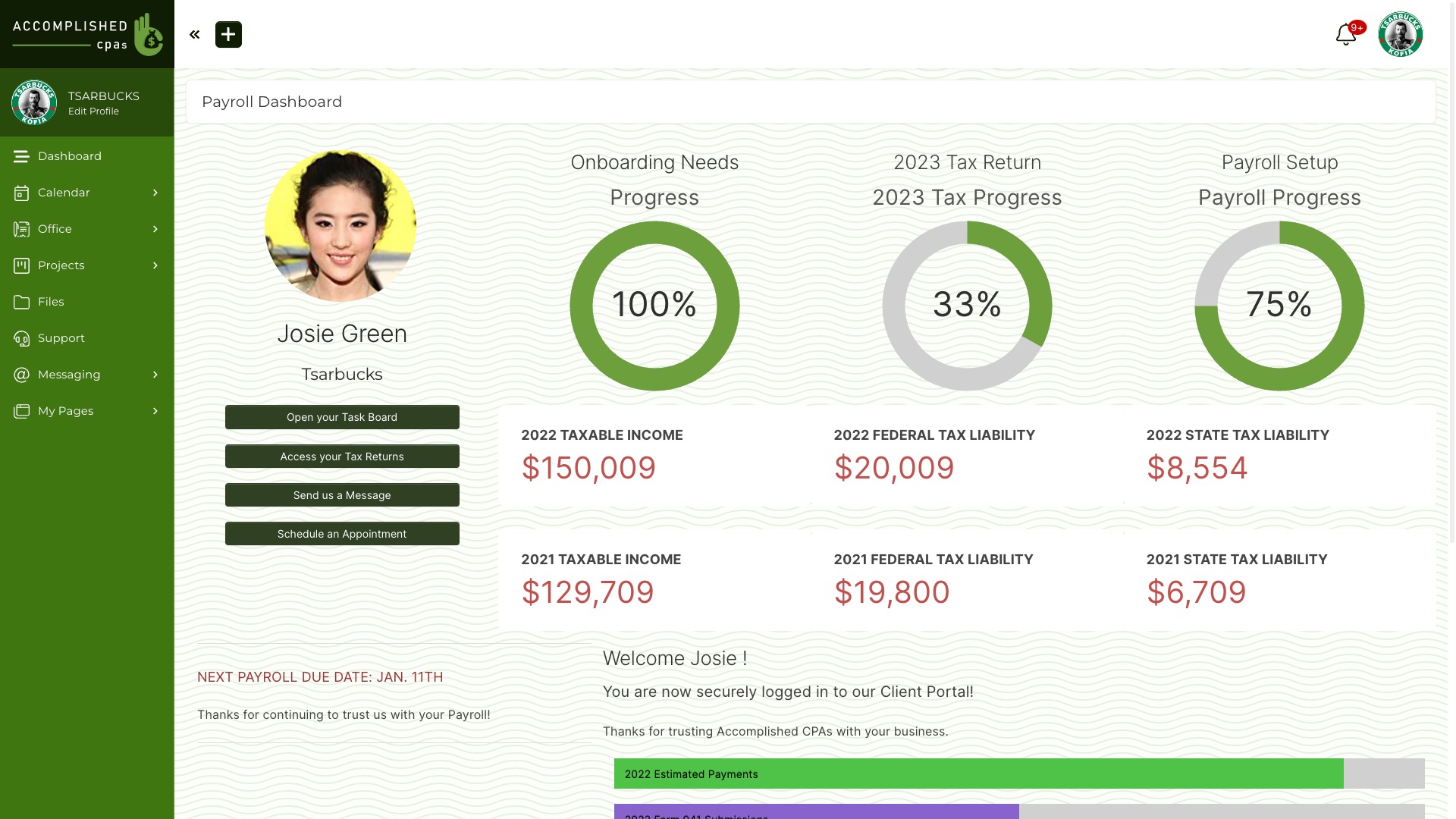
Let us make this concrete. Say you are an accounting firm with four main service lines: bookkeeping, tax prep, wealth management, and payroll. You create four Circles – one for each service line. For each Circle, you configure which Dashboard they land on, which menu items they can see, which shared folders they can access, and which Portal Pages are visible to them.
Now when a new bookkeeping client comes in, you place them in the Bookkeeping Circle. Done. They log in and see exactly what a bookkeeping client should see – their own data, their own documents, but wrapped in the experience you designed for bookkeeping clients specifically. No manual setup. No toggling visibility settings one by one. No forgetting to share the right folder three weeks in.
One Contact, Multiple Circles
Here is where it gets more useful. A single Contact can belong to more than one Circle at the same time.
Some of your accounting clients are in all four service lines. Others are only in one. That is fine. A Contact in both the Bookkeeping Circle and the Tax Prep Circle sees the combined experience of both. The portal adapts based on which Circles are assigned – not based on you remembering to toggle each setting individually.
This is the part that tends to compound. Because as your business grows and you add new service lines or new client segments, you are not rebuilding the portal from scratch. You are creating a new Circle, configuring its experience once, and assigning people to it. The structure scales with you instead of against you.
A Real Example: Teaching Your Clients to Prepare
Take the accountant again. Tax season is coming, and you need your tax prep clients to gather their documents in a specific way. You have built resources for them – guides, checklists, maybe a dedicated Portal Page that walks them through exactly what to prepare and how to submit it.
Without Circles, you would be manually adjusting visibility for every tax prep client so those resources show up. With Circles, those Portal Pages and shared folders live inside the Tax Prep Circle’s portal experience. Every Contact in that Circle sees what they need when they log in. A bookkeeping-only client never sees tax prep materials cluttering their view.
You can extend this pattern as far as your business needs it. Onboarding Circles for new clients. VIP Circles for your highest-value accounts. Circles for clients in a specific phase of a project. The mechanism is the same every time: define the group, configure the experience, assign the people.
If you also use SuiteDash LMS on Pinnacle, grant courses the way the product documents – per Contact, from the Product Owners tab, during Contact creation, or via a Kickoff Form submission. Circles shape the portal they land in; LMS ownership stays on those documented grant paths.
What Actually Changes for You
The shift is subtle but it matters. Instead of thinking about each client as a unique setup problem, you start thinking in terms of client types. What does a payroll client need to see? What does a new client need during their first thirty days? What should a retainer client have access to that a project client should not?
You answer those questions once. You build the Circle once. And then every future client who fits that pattern gets the experience without you touching anything.
That is not a small thing. It means your fiftieth client takes the same effort as your fifth. It means a new staff member can onboard a client by placing them in the right Circle instead of following a twelve-step setup checklist. It means your portal feels personalized to every client type without you personally personalizing it.
Getting Started
If you are already using SuiteDash and you have not set up Circles yet, start with the most obvious split in your client base. For most service businesses, that is the different service lines you offer. Create one Circle per service line, configure the Dashboard and menu for each, and start assigning your existing Contacts.
You do not need to build out every Circle on day one. Start with two or three. See how the portal adapts. Then add more as you identify new client segments that need a different experience.
The whole point of Circles is that your portal becomes something that morphs based on who is logging in – not because you are manually adjusting it for each person, but because the structure does the work for you. Design once, reuse at scale. That is the move.
Related reading
Ready to Run Your Whole Business From One Login?
Start your free 14-day trial on the Pinnacle plan. No credit card required. Every toolkit, nothing held back.