Best Client Portal for Accountants (2026)

| Platform | Pricing | White-label | Best for |
|---|---|---|---|
| SuiteDash ⭐ | $19–$99/mo · unlimited users | Full (domain, app, emails) | All-in-one CRM + portal for any size firm |
| TaxDome | ~$80/user/mo | Limited | Tax-prep heavy workflow |
| Karbon | ~$59–$89/user/mo | No | Larger CPA firms with deep workflow needs |
| Canopy | ~$45–$99/user/mo | Module-based | Modular practice mgmt with bolt-ons |
| Clinked | ~$77/mo per workspace | Full | Portal-only, no CRM/accounting features |
| Liscio | ~$55–$80/user/mo | No | Communication-focused, light feature set |
Why Accounting Firms Need a Specialized Client Portal
Generic file-sharing tools weren’t built with firms in mind. They assume ad-hoc document exchange with no recurring structure. Accounting firms operate differently, you repeat the same engagement lifecycle with dozens or hundreds of clients every year: intake, engagement letter, document collection, work product, review, delivery, invoicing, and renewal for next cycle.
A file-sharing tool tracks folders. An accounting client portal needs to track the pipeline and the entire engagement lifecycle: secure tax document exchange, electronic engagement letters, milestone communication with clients, recurring retainer billing, team collaboration on client records, and long-term account history across multi-year relationships.
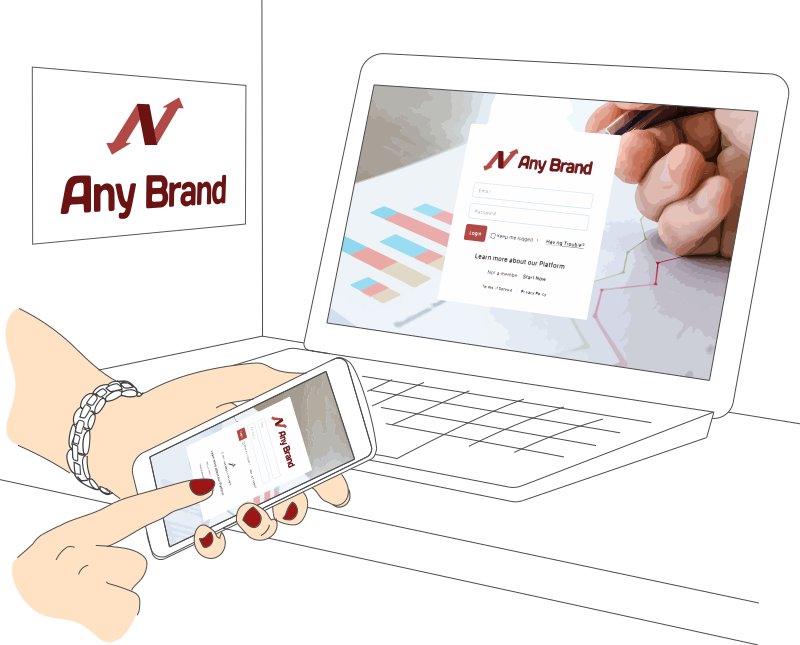
Firms also face a challenge most businesses don’t: regulatory and security expectations. Clients expect their tax documents and financial records to live somewhere more secure than email. Partners expect their firm’s brand to appear on every client touchpoint. A white-label client portal branded with your firm’s logo, colors, and domain communicates competence. Sending clients to a generic third-party login page does the opposite.
The best client portal for accountants isn’t just about document exchange, it’s about managing the entire firm-to-client relationship in a system that makes your firm look polished at every touchpoint.
What to Look for in an Accounting Client Portal
Not every portal feature matters equally for accounting firms. Here are the capabilities that separate a useful firm portal from a generic file-sharing tool.
1. Secure Document Exchange with Audit Trail
Clients upload tax documents, you download them, work happens, you deliver the return. Every step needs to be logged, permissioned, and verifiable. Email-based workflows break all three principles, documents end up in multiple inboxes, attachments vanish, and there’s no record of who accessed what when.
2. Electronic Engagement Letters with E-Signature
Every year’s engagement cycle starts with a new engagement letter. A portal that generates branded letters from templates, collects legally binding e-signatures, and archives executed versions alongside the client record eliminates a multi-tool workflow (Word → DocuSign → filing cabinet) into a single in-portal process.
3. Recurring Retainer Billing Integrated with CRM
Firms running monthly or quarterly retainers need recurring billing that triggers automatically and pulls the right engagement context. Portals that integrate billing with the CRM contact record, rather than requiring a separate QuickBooks sync, eliminate double entry and reconciliation drift.
4. Client Intake Forms with Conditional Logic
New tax-year intake, new service onboarding, changes in scope, every accounting firm has 10+ structured forms clients fill out. A portal with conditional-logic intake forms (only showing spouse questions to married filers, business-entity questions to Schedule C clients, etc.) gets better data with less client friction.
5. Team Permissions and Role Management
Partners, senior accountants, bookkeepers, and admin staff all need different access levels to different clients. Associates see their assigned clients; partners see everything; reviewers see financials but not client communications. A portal that lets you set granular permissions without creating separate accounts for each tool prevents privilege creep and simplifies compliance.
6. White-Label Client Portal
Clients should log into a portal that looks like your firm built it, your logo, your colors, your custom domain. This is table-stakes for firms positioning themselves as trusted advisors. Some platforms offer white-label natively; most require expensive upgrades to a top tier.
7. Cross-Module Workflow Automation
The real payoff is automation that spans modules. When a client signs an engagement letter: automatically send a welcome email, trigger the document-collection workflow, schedule the kickoff call, and create the project milestones. One trigger, a chain of actions across your entire firm, no Zapier required, no separate tools to sync.
8. Multi-Year Client History in One Record
Your relationship with a client spans years. Their portal history should too. Being able to see the 2023 engagement, the 2024 engagement, every document exchanged, every invoice paid, every conversation logged, all from one client record, turns the portal into an institutional-memory system that survives staff turnover.

Top Client Portal Options for Accountants in 2026
There’s no single best portal for every firm. Your ideal platform depends on firm size, client volume, workflow complexity, and how many separate tools you’re willing to manage. Here’s an honest assessment of the leading options.
SuiteDash, Best All-in-One Portal for Accounting Firms
SuiteDash bundles client portal, CRM, project management, invoicing, proposals, engagement letters with e-signature, secure messaging, and automation into one platform. Every module runs on the same shared data layer, so client data flows from intake to engagement to invoice without re-entry or integration middleware.
Best for: Small to mid-size firms (2-50 staff) that want to replace 4-6 separate tools with one platform. Firms that value white-label branding and client-facing professionalism.
Strengths: True all-in-one, no integration tax. White-label portal included at every pricing tier. Flat pricing with no per-staff-member surprises. Cross-module automation (e.g., engagement letter signed → project created → first invoice generated → welcome email sent, all in one workflow).
Limitations: Not built as an accounting-first platform, does not have native integrations with every tax prep package. QuickBooks Online integration is solid but not as deep as accounting-native tools like Karbon or TaxDome. Best fit for firms that value broad operations integration over tax-software-specific depth.
Pricing: Starts at $19/month. All features included at every tier, no module upsells. Unlimited users at every tier. See current pricing.
TaxDome, Best for Firms That Live Inside Tax Prep Software
TaxDome was built specifically for tax and accounting practices. Deep integrations with major tax prep platforms (Drake, UltraTax, Lacerte, ProConnect). Strong document management workflow with electronic signatures and bank-level security.
Best for: Tax-focused firms (2-100+ staff) where the core workflow is tax preparation and filing, not broader advisory or consulting services.
Strengths: Accounting-native feature set. Strong document management with tax-specific workflows. Good integrations with tax prep software. Mobile app is polished. E-signature included.
Limitations: Per-staff pricing can escalate ($60-$90/user/month). CRM and project management are functional but narrower than general-purpose platforms. Not designed for advisory practices that also need marketing automation or general business operations.
Pricing: Per-user starting around $60/month. 3-year contract options offer discounts. Firm of 10 staff typically lands at $500-700/month.
Karbon, Best for Practice Management Integration with Email
Karbon is practice management software with a strong email-centric workflow. It’s particularly popular with firms that manage work via shared inboxes and need visibility across every client email thread.
Best for: Mid-size firms (10-50+ staff) where email is the primary communication medium and practice management + workflow visibility matters more than client-facing portal polish.
Strengths: Excellent email-based workflow. Triage and assignment features for shared inboxes. Good reporting on team capacity and work-in-progress. Integration with Xero, QBO, and other common accounting tools.
Limitations: Per-user pricing with a 10-user minimum makes entry cost high ($590+/month floor). Client-facing portal is secondary to internal workflow. Less suitable for solo practitioners or very small firms.
Pricing: $59/user/month with a 10-user minimum ($590/month floor). 2-3 year contracts offer discounts.
Canopy, Best for Firms Prioritizing Tax Resolution and IRS Workflows
Canopy combines a client portal with tax resolution workflows, transcript retrieval, and IRS representation tools. Built with the unique needs of tax resolution practices in mind.
Best for: Firms doing significant tax resolution work or IRS representation. Practices that need automated transcript retrieval and Notice management.
Strengths: Specialized IRS workflow features no other platform offers. Transcript retrieval automation. Good integration with tax prep packages. Client portal is functional and branded.
Limitations: Modular pricing means features you expect are often upsells. Less applicable if your practice isn’t heavy on tax resolution. User experience has had mixed reviews from non-resolution-focused firms.
Pricing: Modular. Practice management bundle starts around $50-70/user/month. Add-ons for tax resolution, transcripts, and other features increase cost substantially.
Liscio, Best for Modern, Mobile-First Firm Experience
Liscio is a newer client communication platform with a strong mobile app and modern UX. It emphasizes secure messaging and document exchange with a consumer-quality user experience for clients.
Best for: Firms prioritizing client experience on mobile. Practices where clients skew younger or tech-forward. Firms replacing email-based document exchange with a structured alternative.
Strengths: Best-in-class mobile app for clients. Polished UX. Secure messaging that feels like messaging (not a portal). Good document exchange with e-signature included.
Limitations: Narrower than a full practice management platform. Limited project management and billing functionality. Per-user pricing. Smaller integration ecosystem.
Pricing: Per-user pricing starting around $35-50/month depending on tier.
Clinked, Best Pure Client Portal for Cross-Industry Firms
Clinked is a general-purpose client portal used across industries. For accounting firms, it works as a branded document exchange and messaging hub without the accounting-specific features of TaxDome or Karbon.
Best for: Firms that want a clean, branded portal for document exchange but already have separate tools for CRM, billing, and practice management.
Strengths: Good white-label capabilities. Simple to set up. Adequate document and messaging features. Lower cost than full practice management platforms.
Limitations: Not accounting-specific. No engagement letter templates. No tax software integrations. No invoicing. Essentially a portal-only tool that requires other systems for everything else.
Pricing: Starts around $77/month for small teams. Pricing scales by users and features.
Jetpack Workflow, Best for Small Firms Focused on Recurring Work Management
Jetpack Workflow is a lightweight practice management tool optimized for tracking recurring work across clients. Simple interface, focused feature set.
Best for: Very small firms (1-10 staff) that want basic recurring work tracking without the complexity of full practice management platforms.
Strengths: Simple to learn and use. Effective at recurring work visibility. Reasonable price point for small teams.
Limitations: No client portal feature, it’s practice management only. Limited client-facing capabilities. Small feature footprint compared to competitors.
Pricing: Per-user pricing starting around $45/month.

Why SuiteDash Works for Accounting Firms
Most accounting client portals solve one piece of the puzzle well and leave you to assemble the rest. SuiteDash was built to handle the entire firm-client relationship, from first inquiry through engagement, document exchange, billing, and renewal, in one integrated platform.
One Platform Replaces Your Entire Tool Stack
A typical firm tech stack includes a CRM (HubSpot or manual tracking), a practice management tool (Karbon or Jetpack), tax document exchange (SecureFilePro or ShareFile), engagement letters (Word + DocuSign), invoicing (QuickBooks Online), email marketing (MailChimp), and a client portal (separate login or client-facing shared drive). That’s seven subscriptions, seven logins, and constant data syncing between platforms.
SuiteDash replaces all of them. CRM, project management, invoicing and recurring billing, proposals and engagement letters with e-signatures, email marketing, secure messaging, and a branded client portal. One subscription. One shared data layer. One interface for your entire firm.
White-Label Everything
Every client-facing touchpoint in SuiteDash carries your firm’s brand. Your logo, your colors, your custom domain. When clients log in, they see your firm’s portal, not a third-party tool with someone else’s branding. This applies to the client dashboard, engagement letters, invoices, project updates, file sharing, and intake forms. Learn more about white-label capabilities.
Cross-Module Automation
Here’s what happens when a client signs an engagement letter in SuiteDash, triggered by one automation:
- Project is created automatically with the year’s engagement milestones and task templates
- Document collection workflow is triggered, client receives structured intake request
- First invoice is scheduled per the engagement terms
- Welcome email sequence is sent explaining the firm’s process
- Portal access permissions are adjusted to the active-engagement level
- Partner and primary bookkeeper receive internal notifications
No Zapier. No middleware. No “if this breaks, the entire workflow stops” fragility. One trigger, six actions, all happening within the same platform using the same client data.
Built for Firm Economics
SuiteDash uses flat-rate pricing instead of per-staff models. This matters for accounting firms because partners, associates, bookkeepers, admin staff, and seasonal tax-season contractors all need access, but seasonal scale shouldn’t trigger bill shock. See pricing details.
Client-Resell Option via SU1TE and AUTOP1LOT
Bookkeepers and accountants with audience or operational expertise in a vertical have a second option: resell the platform under their own brand. The SU1TE Partner Program lets firms turn SuiteDash into a productized offering for their niche, a differentiator no other accounting platform provides.
Best Client Portal by Firm Type
Different firm models have different portal priorities. Here’s how the top platforms align.
Solo Practitioners and Small Firms (1-5 Staff)
Priority: affordable all-in-one. A solo CPA or small bookkeeping firm doesn’t have budget for enterprise tool stacks. Consolidation wins.
Top picks: SuiteDash at $19-99/month (all-in-one, unlimited users). Liscio for mobile-first client communication. Jetpack Workflow if recurring work visibility is the only need.
Mid-Size Tax-Focused Firms (5-30 Staff)
Priority: tight tax-software integration and client document workflows.
Top picks: TaxDome if tax prep software integration is mission-critical. SuiteDash for firms that want broader operations coverage without losing client-portal polish.
Mid-Size Advisory + Full-Service Firms (5-30 Staff)
Priority: managing advisory work alongside compliance. Less tax-prep-software dependency.
Top picks: SuiteDash for full operations coverage with CRM, projects, and billing. Karbon for email-centric workflow management if you’re not price-sensitive.
Larger Firms (30+ Staff)
Priority: team collaboration, permission management, reporting across dozens of simultaneous engagements.
Top picks: Karbon for established practice management at scale. TaxDome for tax-heavy larger practices. SuiteDash for firms wanting to keep one platform across all operations.
Bookkeepers Serving Specific Verticals
Priority: delivering a branded, productized experience to niche clients.
Top picks: SuiteDash with SU1TE Partner Program, lets a bookkeeper package their expertise into a branded, white-labeled software offering for their niche. Liscio for modern mobile client experience.
Accounting Client Portal Pricing Comparison
Pricing is where portal decisions get complicated. Per-user pricing, module upsells, minimum-seat requirements, and feature gates mean the advertised starting price rarely reflects what firms actually pay. Here’s a realistic breakdown.
SuiteDash
Starts at $19/month (Start tier). Pinnacle tier at $99/month. All features included at every tier, differences are in storage limits and volume. No per-staff pricing. No module upsells. A 15-staff firm pays the same monthly fee as a 3-staff firm. See full pricing.
TaxDome
Per-user pricing. Around $60-90/user/month depending on tier and contract length. A 10-staff firm typically spends $600-900/month. Annual or multi-year contracts offer meaningful discounts.
Karbon
$59/user/month with a 10-user minimum ($590/month floor). Firms below 10 staff pay for seats they don’t use. 20-staff firms pay $1,180+/month.
Canopy
Modular pricing. Practice management bundle starts around $50-70/user/month. Add tax resolution modules, transcript retrieval, and other features and costs climb quickly to $100+/user/month for full-featured deployments.
Liscio
$35-50/user/month depending on tier. A 10-staff firm: $350-500/month just for client communication (you’ll still need separate CRM, billing, practice management).
Clinked
Starts around $77/month for small teams. Scales by users and storage. Portal-only tool, add other systems for CRM and billing.
Jetpack Workflow
$45/user/month. Small firms (5 staff) land around $225/month. No client portal, add separately.
The Real Cost Comparison
For a typical 10-staff firm that needs client portal + CRM + engagement letters + invoicing + document exchange + practice management:
- SuiteDash: $99/month (everything included, unlimited users)
- TaxDome: $600-900/month
- Karbon + separate billing + portal: $800-1,200/month
- Clinked + Pipedrive CRM + QuickBooks + PandaDoc: $500-800/month
- Canopy (all modules) + CRM: $700-1,100/month
How to Choose the Right Portal for Your Firm
Start with your firm’s primary pain point, not a feature checklist.
If your biggest problem is tool sprawl…
You’re paying for 5-8 separate tools, data doesn’t sync properly between them, and your team wastes hours on manual workarounds. Look at SuiteDash, the only all-in-one option in this list that genuinely replaces your full stack.
If your biggest problem is tax prep software integration…
Your practice lives inside UltraTax, Drake, Lacerte, or ProConnect, and every extra minute of data re-entry costs billable time. Look at TaxDome, it’s built around tax prep integration depth.
If your biggest problem is team workflow visibility across many engagements…
You have 20+ staff running dozens of simultaneous engagements and email is becoming unmanageable. Look at Karbon, its email-centric workflow model is built for this scale.
If your biggest problem is tax resolution and IRS workflow…
Your practice does significant resolution work and needs transcript retrieval, Notice management, and resolution-specific workflows. Look at Canopy, no other platform matches its resolution feature set.
If your biggest problem is a clunky client experience driving churn…
Your clients complain about your portal being hard to use or inaccessible on mobile. Look at Liscio, its mobile-first design is a clear step up in client UX.
If your biggest problem is productizing your firm for a niche…
You want to package your expertise and sell a branded, software-enabled offering to your audience. Look at SuiteDash with SU1TE Partner Program, no other option in this list gives you that path.
Accounting Client Portal: Frequently Asked Questions
What is the best client portal for small accounting firms?
For firms under 10 staff, SuiteDash offers the best combination of features and price ($19-99/month all-in-one, unlimited users). TaxDome is the strong alternative for tax-focused practices where tax prep software integration is critical. Liscio provides excellent mobile UX if client communication is the primary need. Jetpack Workflow handles recurring work tracking at low cost but requires other tools for CRM and portal.
How much does a CPA client portal cost?
The answer depends on what features are included. Portal-only tools like Clinked start around $77/month. All-in-one platforms like SuiteDash start at $19/month (unlimited users). Tax-focused platforms like TaxDome run $60-90/user/month ($600+/month for a 10-person firm). Most firms end up paying $500-1,500/month once they add CRM, billing, practice management, and portal together, which is why consolidated platforms like SuiteDash often save 60-80% compared to separate best-of-breed tools.
Can I brand the client portal as my firm?
Yes, if you choose the right platform. SuiteDash offers full white-label at every pricing tier, custom domain, logo, colors, and branding across every client-facing surface. TaxDome, Karbon, Canopy, and Liscio offer partial branding (logo, colors) but typically not custom domains without upgrade fees. Clinked has good white-label capabilities at its tier pricing. If white-label is a priority, SuiteDash and Clinked are the most cost-effective options.
Does SuiteDash integrate with QuickBooks?
SuiteDash has a QuickBooks Online integration that syncs client records and invoices. It’s adequate for most bookkeeping firms but not as deep as accounting-native tools like Karbon or TaxDome, which have broader QB workflows built into their core product. Firms whose entire workflow runs through QuickBooks may prefer Karbon or TaxDome. Firms using SuiteDash for broader operations (CRM, projects, proposals, email marketing) and treating QB as the general ledger typically find the integration sufficient.
How do accounting firms securely exchange tax documents with clients?
The best practice is a client portal with audit logging, permission controls, and bank-level encryption in transit and at rest. Email attachments are the most common but least secure method, firms using email-based exchange are vulnerable to misdirected attachments, spam-filter loss, and absence of audit trails. All the platforms in this guide (SuiteDash, TaxDome, Karbon, Canopy, Liscio, Clinked) meet security standards suitable for tax document exchange, with their differences being UX, accounting-specific feature depth, and pricing model.
Can I automate client onboarding for every new tax year?
Yes, if your platform supports cross-module automation. SuiteDash is particularly strong here, one engagement-letter signature can trigger project creation, intake-form dispatch, first invoice generation, and onboarding-email sequence simultaneously. TaxDome has strong document-workflow automation specific to tax engagements. Karbon automates work assignment and email triage. General-purpose portals like Clinked have limited automation without bolting on Zapier. For firms that repeat similar engagement cycles with many clients, cross-module automation saves 10-20 minutes per client onboarding.
What’s the difference between Karbon and TaxDome?
Karbon is a practice management platform optimized for email-centric workflows and team coordination across many engagements. TaxDome is built around tax document management and integration with tax prep software. Karbon excels at “what work is each team member doing right now” visibility; TaxDome excels at “the full tax engagement lifecycle.” Karbon’s per-user pricing with 10-user minimum makes it expensive for small firms; TaxDome’s per-user pricing applies regardless of firm size. Choice depends on whether your primary friction is team coordination (Karbon) or tax-workflow execution (TaxDome).
Can a solo bookkeeper use a full practice management platform?
Yes. Solo practitioners often benefit MORE from integrated platforms than larger firms because there’s no admin support to paper over tool sprawl. For solo bookkeepers, SuiteDash ($19-49/month all-in-one) offers the best price-to-features ratio. Liscio is worth considering if client communication is the primary need. Most per-user platforms (Karbon, TaxDome’s upper tiers) don’t make economic sense for solos.
Can bookkeepers resell a client portal to their clients as a branded service?
Only certain platforms offer this. SuiteDash’s SU1TE Partner Program lets bookkeepers and accountants resell the platform to their clients under their own brand, at wholesale rates ($14-69/month per customer account). Partners set their own retail pricing. No other platform in this comparison offers a similar reseller model for accounting firms, it’s SuiteDash’s most unique feature in this space.
What’s the most affordable client portal for accounting firms?
For firms below 10 staff, SuiteDash at $19/month (Start tier) is the most affordable full-featured option. For client-portal-only needs without CRM or billing, Clinked starting at $77/month works. For tax-focused practices willing to commit to per-user pricing, TaxDome can be affordable for very small firms but scales expensively. The “most affordable” answer depends on whether you need a full practice platform or just a portal, and on how many users you need.
Explore More Accounting Resources
Choosing the right client portal is one piece of building an efficient firm. Explore how SuiteDash supports accounting workflows:
SuiteDash for Accounting Firms, Full platform walkthrough tailored to accounting firm operations.
White-Label CRM for Firms, How to brand your entire client experience under your firm’s identity.
Client Portal Software Overview, Complete guide to client portal capabilities.
SU1TE Partner Program, Turn your firm’s expertise into a branded, recurring-revenue software offering.
SuiteDash Pricing, Transparent pricing with all features included at every tier.