Best Client Portal for Law Firms (2026)

| Platform | Pricing | White-label | Best for |
|---|---|---|---|
| SuiteDash ⭐ | $19–$99/mo · unlimited users | Full (domain, app, emails) | Multi-practice + non-litigation firms |
| Clio | ~$79–$129/user/mo | No | Litigation-focused, deep court-rules library |
| MyCase | ~$39–$89/user/mo | No | Mid-market litigation practices |
| PracticePanther | ~$49–$89/user/mo | No | Solos and small firms wanting simplicity |
| Smokeball | $79+/user/mo | No | High-volume document automation |
Why Law Firms Need a Specialized Client Portal
Generic file-sharing tools weren’t built with firms in mind. They assume ad-hoc document exchange with no regulatory structure. Law firms operate differently, every matter carries compliance requirements most industries never see: attorney-client privilege, ABA Model Rule 1.6 confidentiality obligations, trust accounting separation under Rule 1.15, retention schedules, and jurisdiction-specific deadline calculation.
A file-sharing tool tracks folders. A law firm client portal needs to track the pipeline and the full matter lifecycle: intake, conflict check, engagement letter with e-signature, secure document exchange with audit trail, time-and-billing with proper invoice codes, trust ledger movements, and multi-year matter history, all under your firm’s brand.
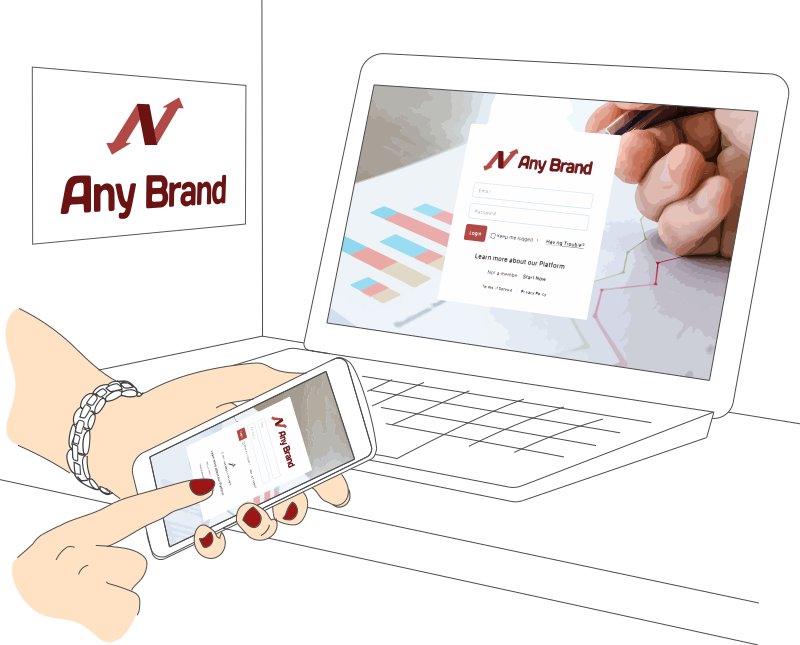
Firms also face a challenge most businesses don’t: clients judge your professionalism by the platforms you put in front of them. A white-label client portal branded with your firm’s logo, colors, and domain communicates competence. Sending clients to a generic third-party portal at someone else’s URL undercuts the authority you spent years building.
The best client portal for law firms isn’t just about document exchange, it’s about managing the entire attorney-client relationship in a system that makes your firm look polished at every touchpoint while staying on the right side of the rules of professional conduct.
What to Look For in a Law Firm Client Portal
Not every portal feature matters equally for law firms. Here are the capabilities that separate a useful firm portal from a generic file-sharing tool.
1. Trust / IOLTA Accounting with Client-Level Ledgers
Most state bars require three-way reconciliation of trust accounts with per-client ledgers and overdraft prevention. Firms handling retainers, settlements, or fee advances need software that enforces separation between operating and trust funds automatically, a Rule 1.15 violation risks bar complaints and disbursement of the wrong funds.
2. Matter-Centric File and Communication Organization
Every document, email, note, task, and time entry should be tied to a matter ID, not a generic “project” or “folder.” When opposing counsel calls about a matter three years later, you need the entire file pulled up in one click, not reassembled from five tools.
3. Conflict-of-Interest Checking
A searchable party and adverse-party database that flags potential conflicts before matter creation is core to compliance for firms of any size. Generic CRMs don’t have this; legal-specific platforms do.
4. Court-Rule-Aware Deadline Calculation
Jurisdiction-specific rules engines (LawToolBox, CalendarRules) for statutes of limitations and response deadlines prevent missed filings, the single fastest path to a malpractice claim. If your practice touches litigation, this is non-negotiable.
5. Legal Document Automation with Template Library
Retainer agreements, engagement letters, pleadings, and demand letters should merge from matter data into firm-standard templates. Hand-drafting every document from scratch is where malpractice creeps in.
6. Time-and-Billing with LEDES / UTBMS Codes
Insurance-defense and corporate-paid billing typically requires LEDES-formatted invoices with UTBMS task codes. Flat-fee or simple hourly billing doesn’t need this, but if any of your clients are institutional, the platform must support it natively.
7. Secure Client Portal Respecting Attorney-Client Privilege
Encrypted messaging, audit trails, and secure internal communication matter far more for law firms than for generic service businesses. Messages, files, and notes inside the portal should be privileged and auditable on request.
8. E-Signature for Engagement and Retainer Agreements
ESIGN/UETA-compliant e-signature chained to the matter record turns a three-step intake process (Word → DocuSign → filing cabinet) into one flow, and keeps a legal-quality audit log without a separate tool.

Top Client Portal Options for Law Firms in 2026
There’s no single best portal for every firm. Your ideal platform depends on firm size, practice areas, compliance needs, and how many tools you’re willing to manage. Here’s an honest assessment of the leading options.
Clio Manage, Deepest Compliance Depth, Highest Cost
Clio is the market leader for small-to-mid firms serious about compliance. The broadest app ecosystem (250+ integrations), strongest three-way trust reconciliation, and widespread bar-association endorsements.
Best for: Firms that need deep trust accounting, LEDES billing, and the full suite of Clio Grow (intake), Clio Draft (document automation), and LawPay payment processing.
Strengths: Most integrations in the category, strongest reconciliation, A.I.-driven Clio Duo insights, widely bar-accepted.
Limitations: Expensive and per-seat. Steep learning curve. Most firms end up paying extra for Clio Grow, Clio Draft, and payment processing on top of the base subscription.
Pricing: Per-user. EasyStart $49, Essentials $89, Advanced $119, Complete $149/user/mo annual. A 10-staff firm on Essentials: ~$890/mo ($10,680/yr) plus add-ons.
MyCase, Best Balance for Small Firms
MyCase (by AffiniPay) is designed for solo and small firms that want a client portal + trust accounting without Clio’s learning curve. Built-in LawPay payment processing and simpler UX.
Best for: Solo and 2-5 attorney firms that want strong client-portal and trust features at a lower learning-curve cost.
Strengths: Client portal at every tier, LawPay native, trust accounting on Basic tier, cleaner UX than Clio.
Limitations: Trust reporting less granular than Clio (manual reconciliation may be needed depending on state). Weaker integration library. Accounting add-on ($39/mo flat) needed for full P&L.
Pricing: Per-user. Basic $39, Pro $79, Advanced $109/user/mo annual. A 10-staff firm on Pro: ~$790/mo ($9,480/yr).
PracticePanther, Easy Onboarding with Strong Automations
PracticePanther (Paradigm) is a clean, fast-onboarding practice management tool with solid workflow automations for firms that want to reduce repetitive admin work.
Best for: Small firms prioritizing ease of use and workflow automation over deep compliance reporting.
Strengths: Clean UI, fast onboarding, strong automations, solid mobile app, trust accounting in higher tiers.
Limitations: Solo plan capped at one user. Reporting shallower than Clio or CARET. Document assembly is basic.
Pricing: Per-user. Solo $49 (1-user cap), Essential $69, Business $89/user/mo annual. A 10-staff firm on Business: ~$890/mo.
Smokeball, Document Automation Leader
Smokeball is a desktop-hybrid practice management platform with the deepest Microsoft Word and Outlook integration in the category plus 20,000+ legal-specific document-assembly templates and automatic passive time capture.
Best for: Small litigation, family, and estate firms where document automation is the core workflow bottleneck.
Strengths: Massive document template library, passive time-tracking, deep Word/Outlook integration.
Limitations: Desktop-hybrid (Windows-only for core app). No public pricing, sales-gated quotes. Historically higher total cost than cloud-only peers.
Pricing: Per-user, quote-only. Tiers estimated at $49-$139/user/mo. A 10-staff firm on mid tier: ~$890/mo estimated.
Rocket Matter, Billing-First for Hourly Practices
Rocket Matter is a billing-focused platform with strong LEDES support, kanban matter management, and matter budgets. Best for firms where hourly billing and WIP control are the primary pain points.
Best for: Small-to-mid firms with hourly-fee billing where invoice precision matters more than broader operational features.
Strengths: Strong billing and LEDES support, matter budgets at Elite tier, full legal accounting at top tier.
Limitations: Dated interface, fewer integrations than Clio, client portal functional but not differentiated.
Pricing: Per-user. Essentials $49, Pro $79, Premier $99, Elite $129/user/mo annual. A 10-staff firm on Pro: ~$790/mo.
CARET Legal (formerly Zola Suite), Native Accounting Without QuickBooks
CARET Legal targets mid-size firms that want native general-ledger and trust accounting built in, no separate QuickBooks sync required. Strong matter management and a built-in email client.
Best for: Mid-size firms (5-20 attorneys) that want accounting, practice management, and portal in one system.
Strengths: Native GL + trust accounting (no QB needed), strong matter management, built-in email client.
Limitations: Pricing opaque and higher than small-firm tools. Implementation fees. Steeper learning curve.
Pricing: Per-user, quote-based. Entry ~$69/user/mo, higher tiers $89-$129+. A 10-staff firm: ~$900-$1,300/mo plus implementation.
Filevine, Purpose-Built for Plaintiff-Side Firms
Filevine is highly customizable case-management software designed for personal injury, mass tort, and plaintiff-side firms handling high case volume. Demand-letter A.I., strong intake management, enterprise reporting.
Best for: PI / mass tort firms with 10+ staff and high case volume where intake management and demand-letter generation are core workflows.
Strengths: Customizable case “projects,” demand-letter A.I. (AIFields), strong intake and lead management, enterprise reporting.
Limitations: Expensive and custom-quoted. Per-integration fees. Overkill for transactional or advisory practices.
Pricing: Per-user, custom quote. Reported start ~$65/user/mo, many firms at $100-$200/user/mo all-in. A 10-staff firm: $8,000-$20,000+/yr.
SuiteDash, All-in-One Alternative for Firms Without Heavy Trust/LEDES Needs
SuiteDash takes a different approach than the vertical-native tools above: instead of deep legal-specific features, it provides an all-in-one operations platform (CRM, client portal, project management, invoicing, proposals, email marketing, automation) with flat pricing, unlimited users, and extreme white-label at every tier.
Best for: Firms whose billing is flat-fee or simple hourly, who don’t handle heavy trust-account volume, and whose pain is per-user pricing and fragmented operations, not LEDES, IOLTA, or conflict-check depth.
Strengths: Flat pricing ($19-$99/mo) with unlimited staff and clients, full white-label on custom domain, integrated marketing/email and automation beyond what legal-native tools offer, SU1TE Partner Program lets firms resell the platform as branded software to their own clients (no legal-native competitor supports this).
Honest limitations: Not a specialized legal platform. No native IOLTA trust accounting, no LEDES/UTBMS billing codes, no conflict-check database, no court-rule deadline engine, no legal-specific document templates. Firms needing any of those should stay on Clio, MyCase, or CARET Legal, or pair SuiteDash with a dedicated trust-accounting tool.
Pricing: Starts at $19/month. All features included at every tier, no module upsells. Unlimited users at every tier. See current pricing.

Why SuiteDash Works for Law Firms Without Heavy Compliance Needs
For firms whose billing is flat-fee, simple hourly, or retainer-based, and whose operational pain is per-user pricing and fragmented client operations rather than LEDES or IOLTA compliance, SuiteDash collapses the tech stack in ways legal-native tools can’t.
One Platform Replaces Most of Your Non-Legal Stack
A typical firm on Clio still pays separately for Mailchimp (email marketing), Calendly (scheduling), DocuSign (e-sign), Dropbox (file exchange), and QuickBooks (accounting). That’s five subscriptions layered on top of a practice management platform that’s already expensive.
SuiteDash consolidates CRM, project management, invoicing, proposals and engagement letters with e-signature, email marketing, secure messaging, and a branded client portal into one subscription. Firms that don’t need LEDES or IOLTA keep more of their legal-operations budget.
Flat Pricing Beats Per-User Pricing for Growing Firms
Clio, MyCase, PracticePanther, Rocket Matter, CARET Legal, and Filevine all bill per user. A 10-staff firm on Clio Essentials runs ~$10,680 per year. SuiteDash Pinnacle is $99/mo flat ($1,188/yr) with unlimited staff and clients. For firms that don’t need legal-specific features, that’s an 85-90% cost reduction on the operational layer, enough to fund dedicated trust accounting software separately if it’s ever needed.
Extreme White-Label at Every Tier
SuiteDash clients log in at app.yourfirm.com on your domain, with your logo, your colors, and your firm’s email sender. Clio, MyCase, and the other legal-native tools brand themselves on the portal, your clients see “Powered by Clio” or equivalent branding. For firms positioning themselves as trusted advisors, the white-label difference is visible at every touchpoint.
The SU1TE Partner Program Opens a Revenue Path Vertical Tools Don’t
Estate-planning attorneys serving small-business owners, business-formation firms, and boutique advisory practices can resell SuiteDash as their own branded software at wholesale ($14-$69/mo per customer account). Clio, MyCase, and the rest offer no reseller model. For firms willing to productize their expertise into a software-enabled service tier, SU1TE wholesale partner program is a unique revenue path.
Cross-Module Automation for the Non-Legal Workflow
When a new client signs an engagement letter in SuiteDash, one automation can simultaneously: create the matter project with task templates, trigger the document-collection workflow, schedule the kickoff call, generate the first invoice, send a welcome email sequence, and notify the assigned attorney and paralegal. No Zapier required, no separate tools to sync, and one canonical source of truth for every client record.
Best Client Portal by Law Firm Type
Different firm models have different portal priorities. Here’s how the top platforms align.
Solo Attorneys
Priority: affordable, easy to onboard, client portal included. A solo attorney doesn’t need enterprise compliance infrastructure on day one.
Top picks: MyCase Basic (portal included, easy onboarding), PracticePanther Solo, SuiteDash (if no IOLTA/LEDES needs and flat pricing beats per-user math).
Small Firms (2-5 Attorneys)
Priority: balance compliance and ease of use. The firm needs trust accounting and matter management but also has limited budget and training time.
Top picks: MyCase Pro for price-sensitive firms, Clio Essentials for compliance-heavy practices, SuiteDash for firms with simple billing models who want consolidated operations.
Mid-Size Firms (5-20 Attorneys)
Priority: reporting, native accounting, and managing dozens of simultaneous matters. Integration depth matters more than ease of use.
Top picks: Clio Complete for integration breadth, CARET Legal for firms wanting native accounting, Rocket Matter Premier for billing-heavy hourly practices.
Larger Firms (20+ Attorneys)
Priority: resource management, enterprise reporting, and specialized workflows. Per-user pricing becomes painful here ($25K-$100K+/yr).
Top picks: CARET Legal, Clio Complete/Enterprise, Filevine for PI/plaintiff-side practices. Consider enterprise stacks (Aderant + NetDocuments) at the top end.
Practice-Area-Specific Firms
Personal injury / mass tort: Filevine, CASEpeer, SmartAdvocate. Family law / estate planning: Smokeball for document automation, Clio for compliance. Immigration: INSZoom, Docketwise. Transactional / corporate: CARET Legal, Clio Complete paired with NetDocuments.
Firms Wanting to Productize as Software
Priority: turn the firm’s expertise into a branded, recurring-revenue software offering for clients (e.g., estate-planning software portal for small-business clients).
Top pick: SuiteDash with SU1TE Partner Program. No legal-native platform offers this reseller model.
Law Firm Client Portal Pricing Comparison
Pricing is where law-firm portal decisions get complicated. Per-user pricing, add-ons for intake and document automation, and payment-processing fees mean the advertised starting price rarely reflects what a firm actually pays. Here’s a realistic breakdown for a 10-staff firm.
Clio
Essentials $89/user/mo annual → ~$890/mo base. Add Clio Grow (~$49/user/mo), Clio Draft (~$49/user/mo), and LawPay processing fees and realistic total climbs to $1,500-$2,500/mo.
MyCase
Pro $79/user/mo annual → ~$790/mo. Add MyCase Accounting ($39/mo flat) and LawPay fees. Realistic 10-staff firm total: ~$850-$1,000/mo.
PracticePanther
Business $89/user/mo annual → ~$890/mo. Trust accounting built-in at this tier. Simpler pricing than Clio but no included payment processing.
Rocket Matter
Pro $79/user/mo annual → ~$790/mo. Premier or Elite (~$99-$129/user/mo) for native accounting and budgets. A 10-staff firm on Premier: ~$990/mo.
CARET Legal
Per-user pricing, quote-based. Entry ~$69/user/mo, mid tiers $89-$129+. A 10-staff firm: ~$900-$1,300/mo plus implementation fees.
Smokeball
Per-user, quote-only. Estimated $49-$139/user/mo. A 10-staff firm on mid tier: ~$890/mo estimated.
Filevine
Per-user, custom quote. Many firms at $100-$200/user/mo all-in. A 10-staff firm: $8,000-$20,000+/yr.
SuiteDash
Starts at $19/month flat (Start tier). Pinnacle $99/month. Unlimited users at every tier. All features included, no module upsells, no per-user pricing. A 10-staff firm pays the same as a 3-staff firm: $99/mo maximum. See full pricing.
The Real Cost Comparison for a 10-Staff Firm
- SuiteDash (no LEDES/IOLTA needed): $99/month flat
- MyCase Pro + add-ons: $850-$1,000/month
- Rocket Matter Premier: ~$990/month
- Clio Essentials + Grow + Draft: $1,500-$2,500/month
- CARET Legal: $900-$1,300/month + implementation
- Filevine: $1,000-$2,500/month
How to Choose the Right Portal for Your Firm
Start with your firm’s primary pain point, not a feature checklist.
If trust accounting and compliance are mission-critical…
Your firm handles retainers, settlements, or fee advances and needs three-way reconciliation with per-client ledgers. Look at Clio, MyCase, or CARET Legal. These are the compliance-grade options.
If document automation is the bottleneck…
Your firm generates dozens of similar documents per matter and data entry is the biggest time sink. Look at Smokeball or Clio Draft, they have the deepest template libraries.
If you’re a plaintiff-side firm with high case volume…
You need intake management, demand-letter generation, and enterprise reporting across hundreds of cases. Look at Filevine, CASEpeer, or SmartAdvocate.
If per-user pricing is crushing you and you have simple billing…
Your firm does flat-fee work, simple hourly, or retainer-based billing. Trust-account volume is minimal or nonexistent. You just want one platform for CRM, client portal, invoicing, and operations. Look at SuiteDash. Flat $19-$99/mo with unlimited staff replaces five tools at 85-90% savings vs. per-user legal software.
If you want to productize your firm’s expertise as branded software…
You advise small businesses on estate planning, business formation, compliance, or similar structured work and want to package that as a software-enabled retainer. Look at SuiteDash with the SU1TE Partner Program, no legal-native competitor offers a reseller model.
If you’re a solo attorney just starting out…
Client volume is low, budget is tight, and you need a professional-looking client experience without spending months on setup. Look at MyCase or SuiteDash. MyCase wins if you need trust accounting out of the box. SuiteDash wins if flat pricing matters more than legal-specific features.
Law Firm Client Portal: Frequently Asked Questions
What client portal do lawyers use?
Most lawyers use a combination of tools rather than a single portal. Clio is the most widely recognized practice management platform among firms serious about compliance. MyCase is popular with solo and small firms that want a balance of compliance and ease of use. PracticePanther and Rocket Matter target small-to-mid firms with simpler requirements. CARET Legal and Filevine serve larger and specialized practices. SuiteDash is increasingly adopted by firms that don’t need legal-specific compliance features and want flat pricing with full white-label.
Is Clio worth the cost for a solo attorney?
It depends on how much trust accounting and compliance depth you need. For solo attorneys handling meaningful trust balances, Clio’s three-way reconciliation and bar-compliant reporting justify the cost. For solo attorneys doing flat-fee work with minimal trust activity, MyCase Basic or SuiteDash Start ($19/mo) often delivers equal or better operational value at 60-80% less cost. The deciding question isn’t features, it’s whether you’ll use the legal-specific compliance depth you’re paying for.
How much does Clio cost vs. MyCase for a 5-lawyer firm?
For 5 attorneys plus support staff (say 8 seats total): Clio Essentials runs ~$712/mo ($89 x 8), before Clio Grow and Clio Draft add-ons. MyCase Pro runs ~$632/mo ($79 x 8), with trust accounting, client portal, and LawPay processing included. MyCase is typically 15-20% cheaper at equivalent tiers, with the tradeoff being shallower reporting and a smaller integration library.
Do I need practice management software as a solo attorney?
If you have fewer than 5 active matters and minimal trust-account activity, a simple spreadsheet plus a secure file-sharing tool may cover the basics. Once you’re juggling 10+ matters, running trust balances, sending engagement letters, and tracking billable time, practice management software prevents compliance errors. For solo attorneys, MyCase and SuiteDash make sense at different ends of the spectrum, MyCase for trust-heavy practices, SuiteDash for simple-billing practices wanting broader operational features.
Can I white-label a client portal with my firm’s branding?
Yes, if you choose the right platform. SuiteDash offers full white-label at every pricing tier, custom domain, logo, colors, and branding across every client-facing surface. Clio, MyCase, Rocket Matter, and PracticePanther offer partial branding (logo and colors) but typically not custom domains, and “Powered by” branding remains visible on the portal. If white-label is a priority for firm positioning, SuiteDash is the most cost-effective option, but verify it meets your legal-specific feature needs first.
What’s the best IOLTA trust accounting software in 2026?
Clio, MyCase, CARET Legal, and Rocket Matter all provide bar-compliant trust accounting with three-way reconciliation. Clio has the most mature and widely-reviewed trust reporting; CARET Legal uniquely integrates general-ledger and trust accounting natively (no QuickBooks sync needed). MyCase is the most affordable option with integrated trust. SuiteDash and other general-purpose platforms do not provide native IOLTA reconciliation, firms needing that must use a legal-specific platform or pair SuiteDash with a dedicated tool.
Which legal software supports LEDES billing?
LEDES (Legal Electronic Data Exchange Standard) with UTBMS task codes is typically required for insurance-defense and corporate-paid engagements. Clio, Rocket Matter, CARET Legal, and Filevine support LEDES natively in higher tiers. MyCase supports LEDES in the Advanced tier. Smokeball supports it with configuration. If any of your clients are institutional, confirm LEDES support before selecting a platform, retrofitting is difficult.
Is my law firm’s client portal HIPAA-compliant?
HIPAA compliance matters for firms handling personal health information, medical malpractice, personal injury with medical records, disability cases, and some family-law matters. Clio, MyCase, and CARET Legal all support HIPAA-compliant workflows with signed BAAs (Business Associate Agreements). Verify BAA availability before using any platform to exchange PHI. General-purpose platforms like SuiteDash may require separate vendor BAA negotiation for HIPAA-grade use cases.
Can my law firm resell a white-labeled client portal to clients?
Yes, via SuiteDash’s SU1TE Partner Program. Firms can resell the full SuiteDash platform to their own clients under their firm’s brand at wholesale ($14-$69/mo per customer account). This works particularly well for estate-planning attorneys, business-formation firms, and advisory practices serving small-business clients who benefit from a branded client portal. No legal-native platform (Clio, MyCase, etc.) offers an equivalent reseller model.
How do I switch from Clio to a cheaper alternative without losing matter data?
All major platforms support data export via CSV and most offer structured import assistants. MyCase, PracticePanther, and CARET Legal publish migration guides specifically for Clio transitions. SuiteDash provides general CRM and contact import with optional paid migration assistance for complex cases. Expect 1-3 weeks of parallel operation during transition to verify matter data, time entries, and trust balances match. Plan the switch during a low-matter period (not during active litigation or tax season).
Explore More Law Firm Resources
Choosing the right client portal is one piece of running an efficient firm. Explore how SuiteDash supports firm operations:
SuiteDash CRM Software, Client relationship and intake management for firms.
White-Label Client Portal for Firms, Brand your entire client experience under your firm’s identity.
Project Management and Invoicing, Matter-style organization with integrated billing.
Secure Client Messaging, Encrypted communication respecting attorney-client privilege.
SU1TE Partner Program, Turn your firm’s expertise into a branded, recurring-revenue software offering.
SuiteDash Pricing, Flat pricing with all features included at every tier.