White Label Business Software
White label business software lets you take a pre-built platform, apply your own branding, and deliver it to clients as if you built it yourself. No development team. No server infrastructure. No ongoing code maintenance. Your logo, your domain, your colors — your business.
For agencies, consultants, and resellers, white labeling is the fastest path to offering software-backed services without becoming a software company. Instead of pitching clients on tools you don’t own, you deliver a branded platform that looks and feels like your own product.
The white-label software market spans everything from CRM and client portals to billing engines, email marketing platforms, and project management suites. Some platforms offer cosmetic branding only (swap a logo). Others allow deep customization — custom domains, custom email senders, custom mobile apps, and complete removal of the vendor’s name from every client touchpoint.
SuiteDash includes full white-label capabilities on every plan, bundling CRM, client portals, invoicing, project management, and email marketing under your brand at a single flat price. This guide explains what white-label business software is, who uses it, what can be customized, and how to choose the right platform for your business.
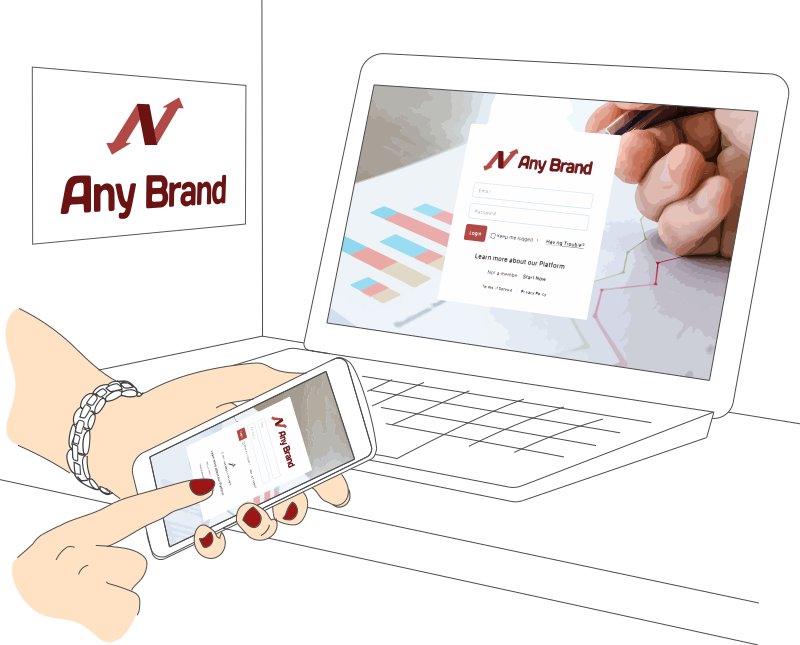
What Is White Label Business Software?
White label business software is a pre-built technology platform licensed to resellers, agencies, or consultants who rebrand the software and deliver it under their own name. The term “white label” comes from consumer goods — generic products packaged in plain white labels that retailers could brand and sell as their own.
In software, the same principle applies. A vendor builds a functional product (CRM, portal, billing engine, etc.) and licenses it to businesses that want to offer that functionality without building it from scratch. The reseller applies their own branding — logo, colors, domain, email templates — and clients experience the product as if the reseller built it.
Categories of White Label Business Software
White-label software exists across nearly every business category. The most common include:
1. White Label CRM
Customer relationship management platforms rebranded for agencies and consultants managing client relationships on behalf of their own customers. A marketing agency, for example, uses a white-labeled CRM to manage their clients’ sales pipelines, delivering the CRM as a branded service.
2. White Label Client Portals
Branded dashboards where clients log in to view projects, invoices, documents, and communications. A white-label client portal replaces your vendor’s URL with yours. Clients see yourcompany.com, not vendor.com.
3. White Label Billing and Invoicing
Subscription management, recurring billing, and invoicing tools rebranded for agencies that bill clients on behalf of their own customers or resellers offering SaaS-like subscription services.
4. White Label Email Marketing
Email automation and drip campaign tools branded as your own platform. Clients send email campaigns through “Your Agency’s Email Platform” — powered by a white-label backend they never see.
5. White Label Project Management
Task management, time tracking, and project collaboration tools rebranded for agencies managing client work. The project dashboard, notifications, and reports all carry your brand instead of the vendor’s.
6. White Label Marketing Automation
Lead nurturing, funnel automation, and customer journey platforms branded as your own. Agencies often resell white-label marketing automation as part of a managed service.
Why Businesses Choose White Label Software
Building custom software costs hundreds of thousands of dollars and takes 12-36 months. White-label software eliminates that investment entirely. Instead of paying developers to build a CRM or portal, you license an existing platform, brand it as your own, and launch in days. The vendor handles security patches, feature development, and infrastructure. You focus on serving clients.

Who Uses White Label Business Software?
White-label software is valuable anywhere a business wants to deliver software-backed services without building and maintaining their own platform. Several categories of businesses dominate white-label adoption.
Digital Marketing Agencies use white-label platforms to deliver CRM, email marketing, and reporting dashboards to their clients under the agency’s brand. Instead of telling clients “log into HubSpot,” the agency says “log into Your Agency’s Platform.” This strengthens client retention — when clients feel locked into the agency’s proprietary tools, they’re less likely to leave.
Business Consultants white-label client management platforms to offer a professional, branded experience. A consultant’s clients log into a portal bearing the consultant’s logo, review documents, pay invoices, and communicate — all through the consultant’s white-labeled system.
Software Resellers license white-label platforms and resell them as their own SaaS products to specific niches. A reseller might take a white-label CRM, brand it for the dental industry, and sell it as “DentalFlow CRM” — a niche-focused product powered by the same white-label backend.
Franchises and Multi-Location Businesses use white-label platforms to deliver a unified branded experience across all locations. Instead of each franchisee running their own tools, the parent company licenses a white-label platform branded with the franchise identity and distributes it to every location.
Professional Services Firms (law firms, accounting practices, financial advisors) white-label portals and communication tools to project a polished, professional image. Clients never see generic vendor branding — only the firm’s own identity.
Coaches and Online Course Creators use white-label platforms to host courses, manage memberships, and deliver coaching through branded portals. The creator’s students experience “Coach Smith’s Academy” — not a generic vendor site.
The Common Thread
Every business above shares one goal: deliver software functionality without revealing which vendor powers it. White-label software makes this possible by giving resellers and agencies complete branding control over what clients see and experience.

The White Label Spectrum: From Logo-Swap to Full SaaS Reselling
Not all white-label software is created equal. The depth of customization varies dramatically across platforms. Understanding the white-label spectrum helps you choose the right platform for your business.
Level 1: Cosmetic Branding
The simplest form of white labeling. You upload a logo, pick a color scheme, and the vendor’s branding is replaced in the header. Everything else — URLs, emails, mobile apps, login pages — still displays vendor branding. Clients who look closely can easily identify the vendor.
Best for: Businesses that need light branding polish but don’t require full identity concealment.
Level 2: Branded Interface
Logo, colors, and custom CSS theming across the entire application. The user interface looks completely custom. However, the URL is still vendor-domain.com, and system emails still come from the vendor. Internal navigation and UX are fully branded.
Best for: Agencies delivering software as a branded experience, but where clients understand a third-party tool is involved.
Level 3: Custom Domain White Label
Your clients log in at app.youragency.com instead of vendor.com. The URL bar shows your brand. System emails come from your domain. The entire experience feels like your proprietary platform. Clients have no visual cue that a vendor is involved.
Best for: Agencies and consultants who want clients to experience the platform as their own product.
Level 4: Full SaaS Reseller
Everything in Level 3 plus: branded mobile apps in the App Store under your name, custom marketing websites, public signup pages, and the ability to resell subscriptions to end customers as your own SaaS product. You’re not just using software for your business — you’re selling the software as your own product to others.
Best for: Software resellers and entrepreneurs building niche SaaS businesses on top of proven white-label backends.
Where SuiteDash Fits
SuiteDash delivers Level 3 white labeling on every plan — custom domain, branded emails, custom login page, and complete visual customization. Higher tiers add custom mobile app branding, fully branded system emails, and the depth needed for SaaS reselling. Most white-label competitors charge $300-$1,000/month for comparable capabilities. SuiteDash starts at $99/month.

What Can Be White-Labeled?
When evaluating white-label business software, examine exactly which elements can be customized. The more touchpoints you can brand, the more complete the white-label experience becomes.
Custom Domain
Your clients access the platform at a URL you control — app.youragency.com instead of vendor.com. This is the single most important white-label feature. Without a custom domain, clients see the vendor’s brand every time they log in.
Branded Login Page
The login page displays your logo, colors, and custom copy. Clients see your brand from the moment they sign in. Some platforms let you fully customize HTML/CSS on the login page for complete control.
Custom Dashboard and Interface
The application itself carries your brand. Logo in the header, color scheme throughout, custom typography, and vendor branding completely hidden from navigation, buttons, and menus.
Branded System Emails
When the platform sends notifications (new invoice, password reset, task assignment), emails come from [email protected] — not the vendor’s domain. The email body carries your branding, not the vendor’s.
Custom Client Portal
The portal clients access for projects, documents, and communication is fully branded. A white-label client portal feels like your proprietary application.
Branded Mobile Apps
Some white-label platforms offer branded mobile apps — your logo in the App Store, your name on the icon, your splash screen when the app opens. Higher-tier white-label platforms include this capability.
Custom Billing Statements and Invoices
Invoices sent through the platform display your company details, logo, and contact information. Clients paying invoices see your brand, not the vendor’s.
Custom Terms and Support URLs
Help links, terms-of-service links, and support contacts point to your resources — not vendor documentation. If clients need help, they contact you, reinforcing the illusion that you built the platform.
Custom Automated Messages
Every automated system message — welcome emails, onboarding sequences, payment reminders — can be customized to match your brand voice and eliminate any trace of the vendor’s defaults.
Custom SMTP and Email Domain Authentication
Advanced white-label platforms let you route all outgoing email through your own SMTP server with SPF, DKIM, and DMARC configured to your domain. This ensures deliverability and email headers that reveal no trace of a third-party vendor.
Not every platform offers all of these customization points. Cheaper white-label solutions stop at logos and colors. Full white-label platforms like SuiteDash include all of the above — custom domain, branded emails, system messages, support links, billing, and more.
Why SuiteDash Is a Leading White Label Business Platform
Most white-label platforms specialize in one capability — white-label CRM, white-label billing, or white-label email marketing. SuiteDash takes a different approach. A single branded platform delivers CRM, client portals, invoicing, project management, email marketing, proposals, file sharing, and team communication — all under your brand, all integrated.
1. All-in-One Under Your Brand
Instead of paying for five different white-label tools from five different vendors, SuiteDash consolidates everything into one branded platform. Your clients log in once to access every service you deliver. You manage one white-label subscription, not five.
2. Complete Customization at Every Tier
Every SuiteDash plan includes custom domain, branded login, branded emails, and full UI customization — not just enterprise tiers. Most competitors reserve custom-domain white labeling for $300-$1,000/month plans. SuiteDash includes it starting at $99/month.
3. Depth That Competes with Custom Development
SuiteDash’s white-label configuration covers every touchpoint — custom CSS theming, custom email templates, custom automated message sequences, custom mobile app branding on higher tiers, and deep SMTP integration. The depth rivals what agencies would spend $100,000+ to build from scratch.
4. Built for Agencies and Resellers
SuiteDash designs the platform around the agency-client relationship. Features like multi-client portals, team member permissions, custom client-facing pages, and the Reseller Program specifically support agencies that want to deliver software as a service under their own brand.
5. Pricing That Reflects Value, Not Modules
Competitors like GoHighLevel charge $297-497/month for white-label CRM alone. Other platforms charge per module — CRM is one price, billing is another, portals are extra. SuiteDash bundles every capability into one flat monthly fee. Agencies saving $500-1,500/month in software costs alone see ROI within weeks.
White Label vs. SaaS Reseller Programs
“White label” and “SaaS reseller” are often used interchangeably, but they describe different business models. Understanding the distinction helps you pick the right path for your business.
White Label: Branded Use
White-label software is about appearance. You license a platform, rebrand it as your own, and use it to deliver services to your clients. Your clients log into a branded portal, but they’re still your clients — you’re using the software to serve them.
Example: A marketing agency white-labels a CRM and uses it to manage their clients’ sales pipelines. The agency pays the vendor a monthly fee. The agency’s clients never pay the vendor directly.
SaaS Reseller: Branded Resale
SaaS reselling is about resale. You license a platform and sell subscriptions to end customers as if you built the software. Your customers pay you for access to the platform. You pay the vendor a wholesale rate. The margin is your profit.
Example: A reseller licenses a white-label platform, brands it as “IndustryApp,” and sells monthly subscriptions to 200 end customers at $99/month each. The reseller collects $19,800/month from customers, pays the vendor a fraction of that, and keeps the margin.
Key Differences
Relationship: In white-label use, clients are your service clients. In SaaS reselling, customers are paying subscribers to your software.
Revenue model: White-label = service revenue (agency fees, consulting retainers). SaaS reseller = subscription revenue (monthly recurring from end customers).
Support responsibility: White-label = you support your clients directly. SaaS reseller = you handle tier-1 support for end customers and escalate to the vendor for tier-2/3.
Legal complexity: White-label = simpler. You use a tool. SaaS reseller = more complex. You need reseller agreements, terms of service for end customers, and sometimes a separate legal entity.
Which Should You Choose?
If you’re an agency or consultant using software to serve existing clients, white-label is the right approach. SuiteDash’s white-label plans fit this model perfectly.
If you want to build a SaaS business selling software subscriptions to a specific niche, SaaS reselling is the right approach. SuiteDash’s Reseller Program specifically supports this model with wholesale pricing and white-label infrastructure.
Implementation Considerations
Launching a white-label platform involves more than swapping a logo. Plan for the following considerations to avoid surprises.
Setup Complexity
Initial white-label configuration — custom domain DNS setup, SSL certificate installation, branded email authentication (SPF/DKIM/DMARC), logo and color configuration, email template customization — typically takes 2-10 hours depending on platform depth. Simpler platforms launch in an afternoon. Deeper white-label systems require multi-day setup but deliver more polish.
Ongoing Maintenance
White-label platforms handle vendor-side maintenance — security patches, feature updates, uptime monitoring, infrastructure scaling. Your maintenance is limited to your branding, client configurations, and custom workflows. This eliminates most of the maintenance overhead that makes custom software expensive.
Branding Consistency
The strongest white-label experiences maintain brand consistency across every touchpoint — login page, dashboard, emails, mobile apps, invoices, support links. Audit every client touchpoint during setup to ensure no vendor branding leaks through. Some platforms excel at visual branding but leak vendor names in email headers, mobile push notifications, or edge-case notification flows.
Feature Limitations vs. Custom Development
White-label platforms deliver pre-built features. If your business needs a truly unique capability no platform offers, custom development remains necessary. For 95% of agency and consulting use cases, however, modern white-label platforms deliver every needed capability — and at a fraction of custom development cost.
Vendor Lock-In Risk
Choosing a white-label platform creates some dependency on the vendor. Evaluate vendor stability, roadmap transparency, data export capabilities, and pricing history before committing. Platforms with strong data export, mature APIs, and predictable pricing reduce lock-in risk.
Client Perception
Some clients care deeply about whether software is “really yours.” Most don’t. For the clients who do care, consider being transparent upfront — “we deliver software through a best-in-class platform we’ve branded as our own.” Transparency often builds more trust than trying to conceal a platform’s origin.
White Label Business Software: Frequently Asked Questions
What is white label business software?
White label business software is a pre-built technology platform that licenses its product to agencies, consultants, and resellers who rebrand the software with their own logo, domain, and visual identity, then deliver it to clients as if they built it themselves. The vendor handles development, security, and infrastructure while the licensee controls all client-facing branding. Common categories include white-label CRM, client portals, billing and invoicing, email marketing, and project management. White labeling eliminates the cost of custom software development while still letting businesses offer branded software-backed services.
How much does white label business software cost?
White-label software pricing varies dramatically. Basic cosmetic white-label features (logo swap, color customization) are often included in standard SaaS subscriptions at $29-99/month. Full white-label packages with custom domain, branded emails, and complete UI customization typically range $99-$1,000+/month. Enterprise white-label platforms can reach $3,000-$10,000/month. SuiteDash offers full white-label capabilities including custom domain and branded emails starting at $99/month — significantly below competitors like GoHighLevel ($297-497/month) or enterprise-tier offerings from HubSpot or Salesforce.
Can I resell SuiteDash as my own software?
Yes. SuiteDash’s Reseller Program is specifically designed for entrepreneurs and agencies who want to build SaaS businesses on top of SuiteDash’s platform. Resellers get wholesale pricing, full white-label capabilities (custom domain, branded emails, custom mobile apps on higher tiers), and the ability to sell subscriptions to end customers under their own brand. This differs from standard white-label use where you’re simply using the platform to serve your own agency clients.
What’s the difference between white label and reseller?
White labeling refers to the act of rebranding software for your own use when serving clients — you’re the end user of the platform and you deliver services through it. SaaS reselling means you license a platform and sell subscriptions to end customers as your own product — your customers pay you subscription fees, and you pay the vendor a wholesale rate. Both models often use the same white-label infrastructure, but the business models differ: white labeling generates service revenue, reselling generates subscription revenue.
Do clients know it’s not built by me?
With a properly configured white-label platform, most clients have no visual cue that third-party software powers the experience. Custom domain, branded login, custom email templates, and custom support links eliminate obvious vendor branding. Technical clients who inspect HTML source or email headers might identify the underlying platform, but for 95%+ of end users, a well-configured white-label platform feels indistinguishable from proprietary software. SuiteDash’s white-label depth — custom domain, custom SMTP, branded system emails, and custom mobile apps on higher tiers — delivers this level of transparency.
What can be white-labeled in business software?
Depending on the platform’s white-label depth, you can customize: custom domain (app.yourcompany.com), branded login page, logo and color scheme, custom CSS theming, dashboard interface, system emails (sender name, domain, body), custom email templates, mobile app branding, invoice and billing statement branding, client portal branding, support URLs, terms-of-service URLs, automated message sequences, and SMTP/email authentication. Cheaper platforms stop at logos and colors. Full white-label platforms like SuiteDash customize every touchpoint a client sees.
Which industries benefit most from white-label business software?
Industries where client relationships drive business value see the highest white-label ROI: digital marketing agencies, business consultants, professional services (law, accounting, wealth management), coaches and course creators, franchises and multi-location businesses, and software resellers building niche SaaS businesses. Any business that delivers software-backed services — project management, CRM, client communication, billing — benefits from white-labeling to strengthen brand perception and client retention.
How long does it take to launch a white-label platform?
Basic white-label setup (logo, colors, branding) takes 1-2 hours. Full white-label configuration including custom domain, SSL setup, branded email authentication, custom email templates, and system message customization typically takes 4-10 hours spread across a few days. Launching a SaaS reseller business on top of a white-label platform takes longer — 2-8 weeks — because you also need marketing websites, pricing pages, reseller agreements, and end-customer onboarding flows. SuiteDash’s guided setup reduces initial white-label configuration to a single afternoon for most users.
Is white-label software cheaper than building custom software?
Dramatically. Custom software development for a business platform (CRM + portal + billing + project management) typically costs $150,000-$500,000 to build and $5,000-$20,000/month to maintain. A white-label equivalent from SuiteDash costs $99-$999/month with zero upfront development cost and zero ongoing maintenance burden. Most businesses that consider custom development find white-label platforms deliver 95%+ of their desired capabilities at 1-2% of the cost.
Can SuiteDash replace multiple separate white-label tools?
Yes. SuiteDash consolidates white-label CRM, client portals, invoicing, project management, email marketing, proposals, file sharing, and team communication into one branded platform. Agencies typically replace 3-7 separate tools (CRM, portal software, email marketing, project management, invoicing) with a single SuiteDash subscription. This consolidation saves $300-$1,500/month in software costs and dramatically simplifies client experience — clients log into one branded platform instead of multiple disconnected tools.
Explore SuiteDash’s White Label Capabilities
White-label business software is one part of the integrated SuiteDash platform. Dive deeper into specific capabilities:
White Label Platform — Complete overview of SuiteDash’s white-label customization, from custom domain to branded mobile apps.
White Label CRM — Rebranded customer relationship management under your own domain and identity.
White Label Client Portal — Branded client portal with custom login, dashboard, and document sharing.
Agency Software — Purpose-built capabilities for agencies delivering services under their own brand.
Client Management Software — Integrated client management across CRM, portal, invoicing, and project delivery.
SuiteDash Reseller Program — Build your own SaaS business reselling SuiteDash under your brand with wholesale pricing.
Pricing — See how SuiteDash’s flat-fee white-label pricing compares to module-based competitors.