Best CRM for Agencies (2026)
Why Agencies Need a Specialized CRM
Generic CRM software is built for sales teams that close deals and move on. Agencies operate differently. You close a deal and then deliver months of ongoing work — managing projects, tracking hours, sending invoices, and maintaining a client portal where your clients can see progress, approve deliverables, and communicate with your team.
A standard CRM tracks the pipeline. An agency CRM needs to track the pipeline and everything that happens after the deal closes: project delivery, recurring billing, client communication, and long-term account management. When those functions live in separate tools, your team burns hours switching between platforms and re-entering data that should flow automatically.
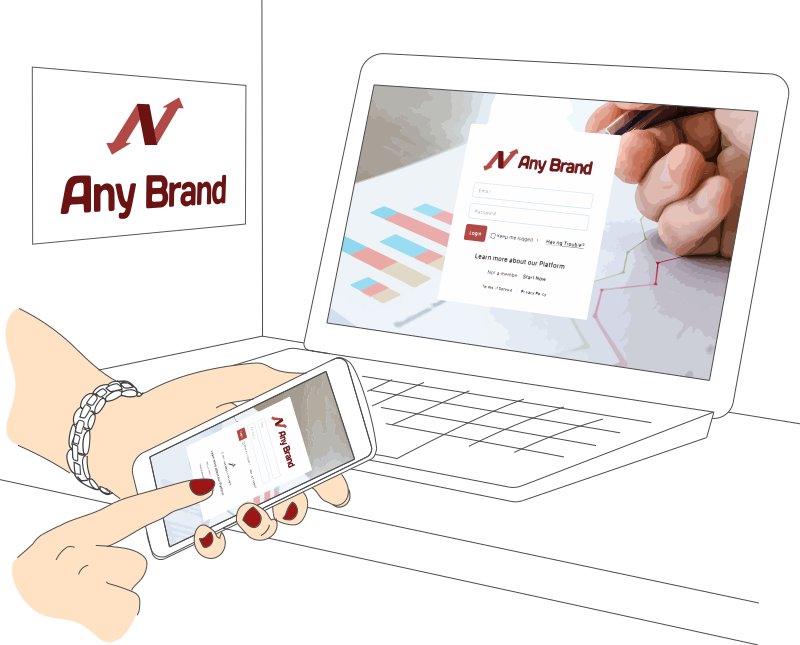
Agencies also face a challenge most businesses don’t: brand perception. Your clients judge your professionalism by the tools you put in front of them. A white-label client portal branded with your agency’s logo, colors, and domain communicates competence. Sending clients to a generic third-party login page does the opposite.
The best CRM for agencies isn’t just about managing contacts. It’s about managing the entire client lifecycle — from first inquiry through project delivery, invoicing, and retention — in a system that makes your agency look polished at every touchpoint.
What to Look for in an Agency CRM
Not every CRM feature matters equally for agencies. Here are the capabilities that separate a useful agency CRM from a generic contact database.
1. White-Label Client Portal
Your clients should log into a portal that looks like your agency built it — your logo, your colors, your custom domain. This is table-stakes for agencies that want to project professionalism. Some CRM platforms offer this natively. Most don’t, forcing you to bolt on a separate portal tool.
2. Multi-Client Project Management
Agencies run 10, 20, or 50 client projects simultaneously. Your CRM should connect directly to project management so when a deal closes, the team transitions to delivery without re-entering client data. Kanban boards, task assignments, time tracking, and milestone management should all live alongside your contact records.
3. Integrated Invoicing and Recurring Billing
Retainer-based agencies need recurring billing that triggers automatically. Project-based agencies need invoicing tied to tracked hours and milestones. Either way, the billing system should pull directly from your CRM contact records and project data — not require manual data entry in a separate accounting tool.
4. Proposals and E-Signatures
Agencies send proposals constantly. A CRM that generates branded proposals from deal data and collects e-signatures in the same platform eliminates the need for DocuSign, PandaDoc, or similar bolt-ons. Faster proposal turnaround means faster deal closure.
5. Pipeline Management with Deal Tracking
Visualize your agency’s sales pipeline with Kanban boards showing deal stages, values, and probability. Track which prospects are closest to signing, which deals have stalled, and which team members are handling which opportunities. Pipeline visibility is critical for revenue forecasting.
6. Workflow Automation Across Modules
The real power of an agency CRM is automation that spans modules. When a deal closes, automatically create a project, generate an invoice schedule, send a welcome email sequence, and assign team members. One trigger, multiple actions across your entire business — no Zapier required.
7. Client Communication Hub
Agencies communicate with clients through email, messaging, file sharing, and approval workflows. A CRM that centralizes all client communication in one searchable thread prevents the “check your email, no check Slack, no check the project tool” problem that plagues multi-tool setups.
8. Team Permissions and Role Management
Account managers, project managers, designers, and developers all need different levels of access. Your CRM should let you control who sees financial data, who can edit client records, and who has access to specific projects without creating separate accounts for each tool.

Top CRM Options for Agencies in 2026
There’s no single best CRM for every agency. Your ideal platform depends on your size, budget, service model, and how many separate tools you’re willing to manage. Here’s an honest assessment of the leading options.
SuiteDash — Best All-in-One CRM for Agencies
SuiteDash bundles CRM, project management, invoicing, proposals, email marketing, automation, and a white-label client portal into one platform. Every module runs on the same shared data layer, so client data flows from pipeline to project to invoice without re-entry or integration middleware.
Best for: Small to mid-size agencies (2-50 people) that want to replace 4-6 separate tools with one platform. Agencies that value white-label branding and client-facing portals.
Strengths: True all-in-one platform — no integration tax. White-label portal included at every tier. Flat pricing with no per-user surprises. Cross-module automation (deal close triggers project creation, invoicing, and onboarding simultaneously).
Limitations: Not built for enterprise-scale sales operations with hundreds of reps. Marketing automation is functional but not as deep as HubSpot’s dedicated marketing hub. Best suited for agencies that prioritize operational integration over specialized sales features.
Pricing: Starts at $19/month. All features included at every tier — no module upsells. See current pricing.
GoHighLevel — Best for Marketing Agencies Selling Automation
GoHighLevel is purpose-built for marketing agencies that want to resell automation services to their clients. It combines CRM, funnel building, SMS/email marketing, reputation management, and appointment scheduling into a white-label platform agencies can rebrand and sell as their own SaaS product.
Best for: Marketing and lead generation agencies that want to productize their services and charge clients a monthly platform fee. Agencies focused on local business clients.
Strengths: Excellent funnel builder. Strong SMS and voice capabilities. SaaS reselling model lets agencies create recurring revenue beyond services. Large community and marketplace of templates. See our detailed comparison.
Limitations: Weak project management — not designed for agencies that deliver complex project work. No native invoicing for agency operations. The platform is marketing-centric; agencies doing web development, creative work, or consulting will need additional tools for delivery. Learning curve is steep.
Pricing: Starts at $97/month (Agency Starter). Unlimited sub-accounts at higher tiers.
HubSpot — Best for Agencies Needing Enterprise Marketing Automation
HubSpot offers a powerful CRM with marketing, sales, and service hubs. The free CRM tier is generous, and the marketing automation capabilities are among the strongest in the market. HubSpot is particularly well-suited for agencies that need advanced content marketing tools, lead scoring, and attribution reporting.
Best for: Larger agencies (20+ people) with dedicated marketing operations, or agencies that use HubSpot for their own clients and want to standardize on one ecosystem. See our detailed comparison.
Strengths: Industry-leading marketing automation. Excellent content management and SEO tools. Strong reporting and attribution. Massive integration ecosystem. Free CRM tier for smaller teams.
Limitations: Pricing escalates rapidly when adding Sales Hub, Service Hub, and Operations Hub. No native project management for client delivery. No white-label option — clients see HubSpot branding. Per-contact pricing on marketing tiers can create bill shock as your database grows.
Pricing: Free CRM available. Professional Marketing Hub starts at $800/month. Adding Sales and Service hubs pushes costs above $2,000/month for most agencies.
Pipedrive — Best for Sales-Focused Agencies
Pipedrive is a sales-first CRM with an intuitive pipeline interface. It’s designed for teams that live in their sales pipeline and want minimal friction between lead capture and deal closure. The interface is clean, fast, and focused on moving deals forward.
Best for: Agencies with dedicated sales teams where pipeline management is the primary need. Consulting firms and staffing agencies with straightforward sales processes.
Strengths: Best-in-class pipeline visualization. Fast, intuitive interface with minimal learning curve. Strong email integration and activity tracking. A.I.-powered sales assistant for deal recommendations.
Limitations: CRM only — no project management, no invoicing, no client portal. You’ll need separate tools for everything post-sale. No white-label capabilities. Marketing automation is basic compared to HubSpot or GoHighLevel.
Pricing: Starts at $14/seat/month (Essential). Professional tier at $49/seat/month. Per-seat pricing adds up quickly for larger teams.
Monday.com — Best for Creative Agencies Prioritizing Project Workflows
Monday.com started as a project management tool and expanded into CRM. Its strength is visual workflow management with highly customizable boards. The CRM module integrates with Monday’s project boards, making it a reasonable choice for agencies that prioritize project delivery over sales pipeline sophistication.
Best for: Creative agencies, design studios, and production houses that need flexible project workflows with basic CRM functionality bolted on.
Strengths: Highly visual and customizable boards. Strong project management DNA. Good for creative workflows with proofing and approval stages. Integrations with design tools (Figma, Adobe).
Limitations: CRM is a secondary feature, not the core product. No invoicing, no client portal, no white-label option. Per-seat pricing with minimum seat requirements at higher tiers. Automation limits on lower plans.
Pricing: Starts at $12/seat/month (Basic). CRM features require Standard tier at $17/seat/month. Minimum 3 seats.
Plutio — Best Budget All-in-One for Solo Agencies
Plutio combines CRM, project management, proposals, invoicing, and a client portal into a single platform aimed at freelancers and small agencies. It covers similar ground to SuiteDash at a lower price point, though with less depth in automation and fewer advanced features.
Best for: Solo consultants and very small agencies (1-5 people) looking for an affordable all-in-one solution without enterprise complexity.
Strengths: Affordable all-in-one pricing. Clean, modern interface. Built-in proposals and contracts with e-signatures. White-label portal available.
Limitations: Automation capabilities are limited compared to SuiteDash or GoHighLevel. Smaller user community means fewer templates and integrations. May not scale well for agencies beyond 10-15 team members. Reporting is basic.
Pricing: Starts at $19/month (Solo). Business tier at $39/month for teams.

Why SuiteDash Works for Agencies
Most agency CRM solutions solve one piece of the puzzle well and leave you to assemble the rest. SuiteDash was built to handle the entire agency workflow — from the first prospect interaction through years of ongoing client management — in one integrated platform.
One Platform Replaces Your Entire Tool Stack
A typical agency tech stack includes a CRM (Pipedrive or HubSpot), a project management tool (Asana or Monday), an invoicing platform (FreshBooks or QuickBooks), a proposal tool (PandaDoc), an email marketing service (Mailchimp), and a client portal (separate login or custom-built). That’s six subscriptions, six logins, six learning curves, and endless data syncing between platforms.
SuiteDash replaces all of them. CRM, project management, invoicing and recurring billing, proposals with e-signatures, email marketing, and a branded client portal. One subscription. One shared data layer. One interface for your entire team.
White-Label Everything
Every client-facing touchpoint in SuiteDash can carry your agency’s brand. Your logo, your colors, your custom domain. When clients log in, they see your agency’s portal — not a third-party tool with someone else’s branding. This applies to the client dashboard, proposals, invoices, project updates, file sharing, and onboarding flows. Learn more about white-label capabilities.
Cross-Module Automation
Here’s what happens when a deal closes in SuiteDash, triggered by one automation:
- Project is created automatically with task templates assigned to team members
- Branded proposal PDF is generated and sent for e-signature
- Recurring invoice schedule is set up based on the deal terms
- Client receives a welcome email sequence introducing your agency’s process
- Client portal access is activated with appropriate permissions
- Account manager receives a notification with the full client brief
No Zapier. No middleware. No “if this breaks, the entire workflow stops” fragility. One trigger, six actions, all happening within the same platform using the same client data.
Built for Agency Economics
SuiteDash uses flat-rate pricing instead of per-seat or per-contact models. This matters for agencies because your team size fluctuates with client load. Adding a contractor for a project shouldn’t trigger a billing change. Growing your contact database shouldn’t create bill shock. See pricing details.

Best Agency CRM by Agency Type
Different agency models have different CRM priorities. Here’s how the top platforms align with specific agency types.
Marketing and SEO Agencies
Marketing agencies need CRM that connects to campaign management, reporting, and client communication. The sales cycle is typically 2-6 weeks, with ongoing retainer relationships lasting months or years.
Top picks: GoHighLevel if you want to resell marketing automation to clients. SuiteDash if you want all-in-one operations with white-label portals where clients track campaign performance. HubSpot if budget allows and you need enterprise-grade marketing analytics.
Web Design and Digital Agencies
Digital agencies deliver project-based work with defined scopes, milestones, and deliverables. The CRM needs tight integration with project management, file sharing, and approval workflows.
Top picks: SuiteDash for integrated CRM-to-project-to-invoice workflow with client portal. Monday.com if project visualization is the top priority and you’ll use separate tools for CRM and billing. Plutio for solo web designers who want affordable all-in-one simplicity.
Creative Agencies and Design Studios
Creative agencies manage visual assets, proofing workflows, and iterative client feedback. CRM needs are often secondary to project and asset management, but the sales pipeline still matters for business development.
Top picks: Monday.com for visual workflow management with design tool integrations. SuiteDash for agencies that want CRM, project management, and client portal in one platform without sacrificing client-facing professionalism.
Consulting Firms and Professional Services
Consulting firms manage long sales cycles (often 3-12 months), complex proposals, and ongoing advisory relationships. CRM needs emphasize relationship tracking, proposal management, and time-based billing.
Top picks: SuiteDash for integrated proposals, CRM, time tracking, and invoicing in one platform. Pipedrive for firms that prioritize pipeline management above all else and will use separate tools for delivery. HubSpot for larger consulting practices with dedicated business development teams.
Agency CRM Pricing Comparison
Pricing is where agency CRM choices get complicated. Per-seat pricing, per-contact pricing, module upsells, and feature gates mean the advertised starting price rarely reflects what agencies actually pay. Here’s a realistic breakdown.
SuiteDash
Starts at $19/month (Start tier). Pinnacle tier at $99/month. All features included at every tier — differences are in storage limits and volume. No per-seat pricing. No module upsells. A 15-person agency pays the same monthly fee as a 3-person agency. See full pricing.
GoHighLevel
Agency Starter at $97/month. Agency Unlimited at $297/month for unlimited sub-accounts. SaaS Pro at $497/month for white-label reselling with custom billing. Realistic agency cost: $297-497/month depending on whether you resell to clients.
HubSpot
Free CRM tier available. Marketing Hub Professional at $800/month. Sales Hub Professional at $90/seat/month. Most agencies using HubSpot seriously spend $1,500-3,000/month across hubs. Per-contact surcharges on Marketing Hub add further cost as your database grows beyond included limits.
Pipedrive
Essential at $14/seat/month. Professional at $49/seat/month. Power at $64/seat/month. A 10-person agency on Professional tier pays $490/month — and still needs separate project management, invoicing, and client portal tools. Realistic total cost with add-on tools: $700-1,000/month.
Monday.com
Basic at $12/seat/month (minimum 3 seats). Standard at $17/seat/month. Pro at $28/seat/month. A 10-person agency on Pro pays $280/month for project management and basic CRM. Add invoicing, email marketing, and client portal tools separately: $500-800/month total.
Plutio
Solo at $19/month. Studio at $39/month for teams. Most affordable all-in-one option for very small agencies. Feature depth is more limited than SuiteDash, particularly in automation and scalability.
The Real Cost Comparison
For a typical 10-person agency that needs CRM, project management, invoicing, email marketing, and a client portal:
- SuiteDash: $99/month (everything included)
- GoHighLevel + project tool + invoicing: $397-597/month
- HubSpot + project tool + invoicing + portal: $1,800-3,200/month
- Pipedrive + project tool + invoicing + portal + email: $700-1,000/month
- Monday.com + CRM add-on + invoicing + portal + email: $500-800/month
How to Choose the Right CRM for Your Agency
Start with your agency’s primary pain point, not a feature checklist.
If your biggest problem is tool sprawl…
You’re paying for 5-8 separate tools, data doesn’t sync properly between them, and your team wastes hours on manual workarounds. Look at SuiteDash or Plutio — all-in-one platforms that consolidate your tech stack into one system.
If your biggest problem is lead generation and marketing automation…
You need sophisticated funnels, SMS campaigns, and the ability to resell automation to clients. Look at GoHighLevel — it’s built specifically for marketing agencies that want to productize their services.
If your biggest problem is enterprise-scale marketing analytics…
You need attribution modeling, advanced lead scoring, and deep content marketing tools. Look at HubSpot — its marketing hub is the industry standard for a reason, and the investment is justified when marketing operations are your core business.
If your biggest problem is sales pipeline visibility…
Your agency’s growth is bottlenecked by an unpredictable sales process, and you need laser focus on moving deals forward. Look at Pipedrive — it does pipeline management better than almost anyone and gets out of the way.
If your biggest problem is project delivery and creative workflows…
Client work gets disorganized, deadlines slip, and approval processes are chaotic. Look at Monday.com — its visual project management is excellent for creative teams, and the CRM add-on handles basic sales needs.
Agency CRM: Frequently Asked Questions
What CRM do most agencies use?
Most agencies use a combination of tools rather than a single CRM. HubSpot is the most widely recognized CRM among larger agencies, particularly those focused on inbound marketing. Pipedrive is popular among sales-driven agencies. GoHighLevel has grown rapidly among marketing agencies that resell automation services. SuiteDash is increasingly adopted by agencies that want one platform to replace their entire tool stack. The “most popular” choice isn’t necessarily the best fit — it depends on whether your priority is marketing automation, sales pipeline, or operational integration.
Is GoHighLevel better than SuiteDash for agencies?
It depends on your agency model. GoHighLevel is stronger for marketing agencies that want to resell a white-label marketing automation platform to clients — the funnel builder, SMS capabilities, and SaaS reselling model are excellent for that use case. SuiteDash is stronger for agencies that need integrated operations: CRM, project management, invoicing, proposals, and client portal in one system. If your agency delivers project work and needs to manage the full client lifecycle from sale through delivery and billing, SuiteDash’s all-in-one approach eliminates the tool sprawl that GoHighLevel doesn’t address for post-sale operations. Read the full comparison.
How much should an agency pay for CRM?
The answer depends on what “CRM” means for your agency. If you only need contact management and pipeline tracking, expect to pay $14-99/seat/month for a standalone CRM like Pipedrive. But most agencies also need project management, invoicing, and a client portal — which adds $200-500/month in additional tools. All-in-one platforms like SuiteDash ($19-99/month total) or Plutio ($19-39/month) bundle everything together, often resulting in 50-80% savings compared to assembling separate best-of-breed tools. Budget $100-300/month for a complete agency operations stack, or $1,500-3,000/month if you choose enterprise platforms like HubSpot.
Can I white-label my CRM for clients?
Not all CRM platforms support white-labeling. SuiteDash offers full white-label at every pricing tier — custom domain, logo, colors, and branding across the entire client portal. GoHighLevel offers white-label capabilities at higher tiers ($297+/month) primarily for reselling the platform to clients. Plutio offers basic white-label portal customization. HubSpot, Pipedrive, and Monday.com do not offer white-label options — your clients will see third-party branding when interacting with these platforms. If white-label is a priority, your realistic options are SuiteDash, GoHighLevel, and Plutio.
What’s the best free CRM for agencies?
HubSpot offers the most capable free CRM tier, including contact management, pipeline tracking, and basic email integration. It’s genuinely useful for agencies getting started. However, the free tier doesn’t include project management, invoicing, proposals, or client portal — which means you’ll need additional free or paid tools to run a complete agency. SuiteDash offers a 14-day free trial with full access to all features, which gives you time to evaluate the complete platform before committing. For agencies, a low-cost all-in-one platform often delivers more value than a free CRM that requires paid add-ons to function.
Do I need a CRM if I’m a solo agency owner?
If you have fewer than five active clients and no sales pipeline to track, a CRM might be overkill. A simple spreadsheet or project management tool covers the basics. Once you’re juggling 5-10+ client relationships with proposals, projects, and invoices flowing simultaneously, a CRM — particularly an integrated one — prevents details from falling through the cracks. For solo agency owners, platforms like SuiteDash or Plutio make sense because they combine CRM with the invoicing and project management you already need, without the complexity of enterprise tools designed for large sales teams.
Explore More Agency Resources
Choosing the right CRM is one piece of building an efficient agency. Explore how SuiteDash supports different agency workflows:
SuiteDash vs GoHighLevel — Detailed comparison for agencies choosing between all-in-one operations and marketing automation reselling.
SuiteDash vs HubSpot — How SuiteDash’s flat-rate integration compares to HubSpot’s modular enterprise approach.
White-Label CRM for Agencies — How to brand your entire client experience under your agency’s identity.
CRM for Marketing and SEO Agencies — Platform walkthrough tailored to marketing agency workflows.
CRM for Web Design and Digital Agencies — How digital agencies use SuiteDash for project delivery and client management.
CRM Software Overview — Complete guide to CRM capabilities and how SuiteDash approaches customer relationship management.
SuiteDash Pricing — Transparent pricing with all features included at every tier.